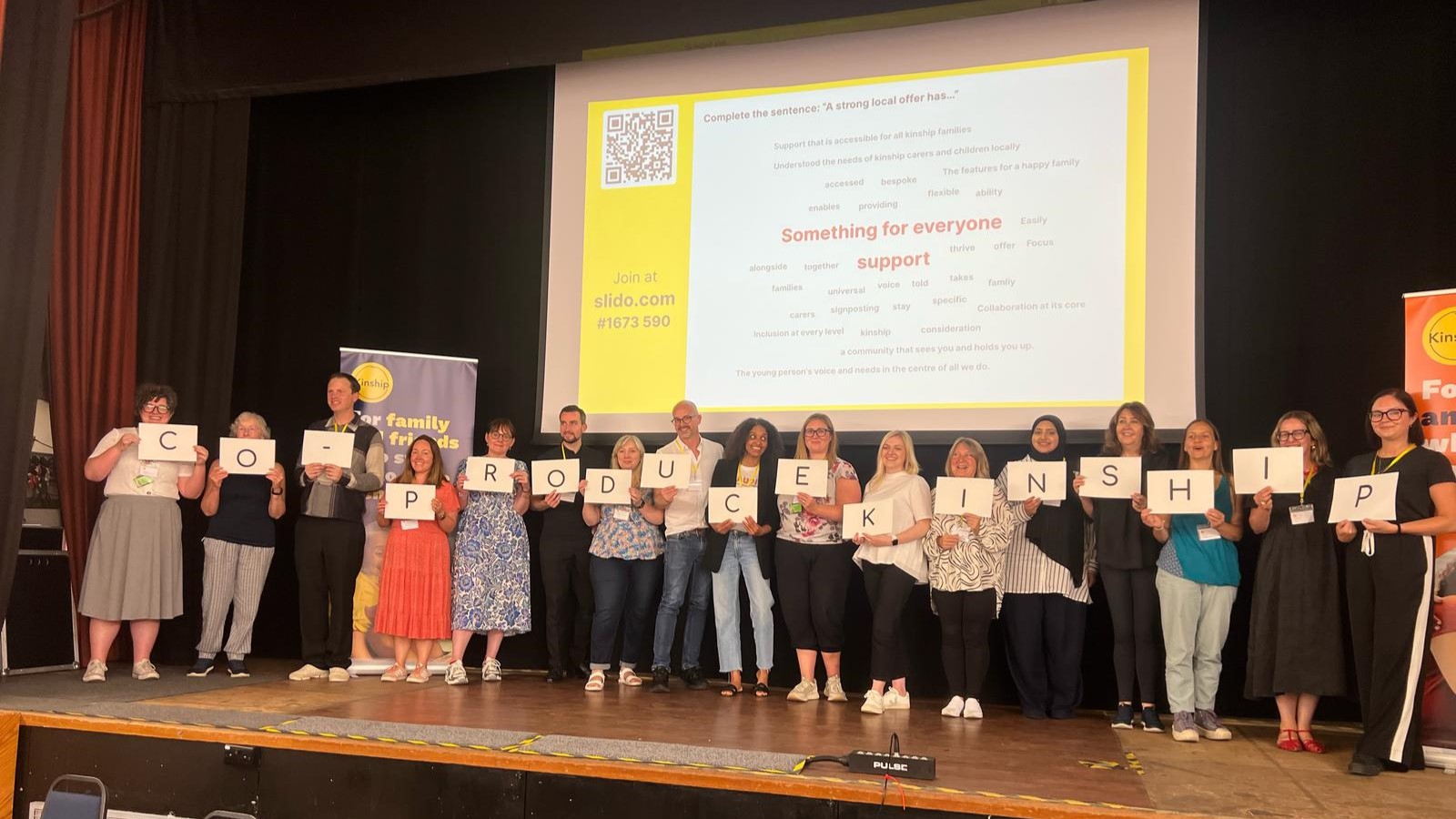
Kinship's Practice Lead, Tim Fisher, reflects on discussions from our Knowledge Exchange event about the kinship care local offer and the value of co-production in local authorities.

For family or friends who step up to raise a child.
Local authorities are responding to updated statutory guidance and Kinship National Standards, and Ofsted has proposed a new inspection framework.
Slow progress
Previous status: Good progress (October 2026); Slow progress (October 2024)
Click on the link below to take you to the section you'd like to read:
Local authorities are continuing to consider their practice and support around kinship care, responding to the publication of recently-updated kinship care statutory guidance in October 2026 and the Kinship Care Practice Guide in October 2024, in addition to the wider emphasis placed on kinship care and family networks within the government’s Families First Partnership programme guide and revised Children’s Social Care National Framework, both updated in March 2026.
Updated statutory guidance reflects legislative changes introduced through the Children’s Wellbeing and Schools Act 2026, including the legal duty on local authorities to consult on and publish a kinship local offer. It also introduces a new set of Kinship National Standards which set out expectations for how local authorities, partners and practitioners should approach kinship care. This includes the delivery of “needs-led support” which recognises the complexity of kinship families, puts the voice of children and young people at the heart of decision making, and reaches all types of kinship family.
Consultations on updated foster care standards and guidance (including a specific quality standard on kinship and family and friends foster carers) and Ofsted’s proposals to update its ILACS framework (including a new specific evaluation area on family networks and kinship care) have recently closed.
In May 2026, the government published its children’s social care implementation plan for local partners, accompanied by an implementation framework produced by Foundations, to support local authorities with the next phase of reform.
Following publication of its fostering policy paper in February 2026 and accompanying consultation, the government confirmed in June 2026 it would not be going ahead with plans to remove the requirement for the use of some fostering panels for kinship foster carers,
Jahnine Davis was appointed by the Department for Education as the National Kinship Care Ambassador in October 2024. The role “advocates for kinship children and carers across government and works directly with local authorities to improve services”. In February 2026, the Ambassador published an insights paper intended to suport local authorities with the implementation of their kinship local offers.
Very minor changes were been made to Ofsted’s inspection guidance in January 2024 to include reference to “kinship care” or “kinship” following commitments made in the National Kinship Care Strategy.
Following its consultation on establishing a new early career framework for children and family social workers, the government instead set out new child and family early career standards in February 2026, which outlines how social workers should learn how to deliver plans which “ensure family members and kinship carers have access to support that addresses current and potential future needs and concerns”.
Through our Professionals’ Network and local offer insights group, we have worked with several local authorities to support them in co-producing their kinship local offers alongside local kinship families. Other welcome changes in local authority practice include restructuring services and teams to consider kinship care in its different forms, delivering improvements to the financial, practical and emotional support offered to kinship families.
It is reassuring that evidence from our 2025 annual survey of kinship carers suggests ratings of local authority support, information and trust from kinship carers are all improving, albeit from a low base. However, our recent research completed a month after the commencement of the legal duty to publish a kinship local offer suggested only around half of local authorities had done so – and fewer than 1 in 5 (18%) kinship carers have seen or been made aware of their kinship local offer.
Foundations’ Kinship Care Practice Guide marked an important step forward in identifying and recognising best practice in supporting kinship families at a time when kinship care awareness and recognition amongst professionals is growing. Its recommendations echo many of those we continue to advocate for local authorities to consider, including specialist support to help kinship carers navigate to and access support, and the use of financial allowances to increase placement permanency and reduce disruption. We are pleased to be working with Foundations on a pilot evaluation of our Kinship Connected navigator programme.
We welcome Ofsted’s plans to increase the emphasis on kinship care within a future inspection framework given its role as a lever for driving strategic change and practice improvement within children’s services. Government direction and local authority practice around kinship care and support for family networks has outpaced the focus placed on this within Ofsted’s existing inspection framework, and we had called for a specific judgement in this area.
Updated fostering regulations and standards to make them more suitable for kinship foster carers are welcome. We argued that more comprehensive changes to the regulatory framework for kinship foster care were required to address this cohort’s specific needs and experiences.
Local authorities should work alongside their kinship families and local peer support groups to build a strong kinship local offer and inform their own practice with kinship families; the National Kinship Care Ambassador should be a key enabler of this. The role should have a strong focus on ensuring all local authorities deliver the essentials well, with priorities aligned to key objectives with the National Kinship Care Strategy and the Children’s Social Care National Framework.
Further practice guidance around kinship care should be built on existing research and evidence in supporting kinship carers, including ‘Key elements of a special guardianship support service’ and ‘Developing good practice in financially supporting special guardians’. It should also address some of the challenges highlighted by specialist social workers who practice in kinship care given its unique mix of skills and knowledge which draw from elements of both child protection and mainstream fostering practice. Where these do not exist already, local authorities should consider establishing specialist kinship teams with the breadth of skills necessary to deliver high-quality social work support.
The government must also ensure local authorities have the core, long-term funding they need to deliver reform and pioneer new ways of working with kinship families; current workforce and financial pressures make the recalibration of services, practice and culture all the more difficult.
20% rated the support from their local authority as excellent or good, up from 12% in 2023
1 in 8 had seen their local authority’s kinship local offer
2 in 5 said they had a named local authority contact who they could go to for support
Kinship's Practice Lead, Tim Fisher, reflects on discussions from our Knowledge Exchange event about the kinship care local offer and the value of co-production in local authorities.
Information and support for professionals working with kinship carers.
View For professionals
Published ahead of Kinship Care Week 2025, Handle With Care shares key findings from our 2025 annual survey of more than 1,900 kinship carers to provide an updated ‘state of the nation’ overview of kinship families and the current policy context.

Learn how Kinship shapes policy and advocates for change. Through collaboration with families and policymakers, we work to ensure kinship carers’ voices are heard and supported across England and Wales.

We carry out research and share it with decision-makers and others to call for improvements in law, policy and professional practice. See all of our research and reports.
Learn more about the kinship families in your local area with our constituency figures.