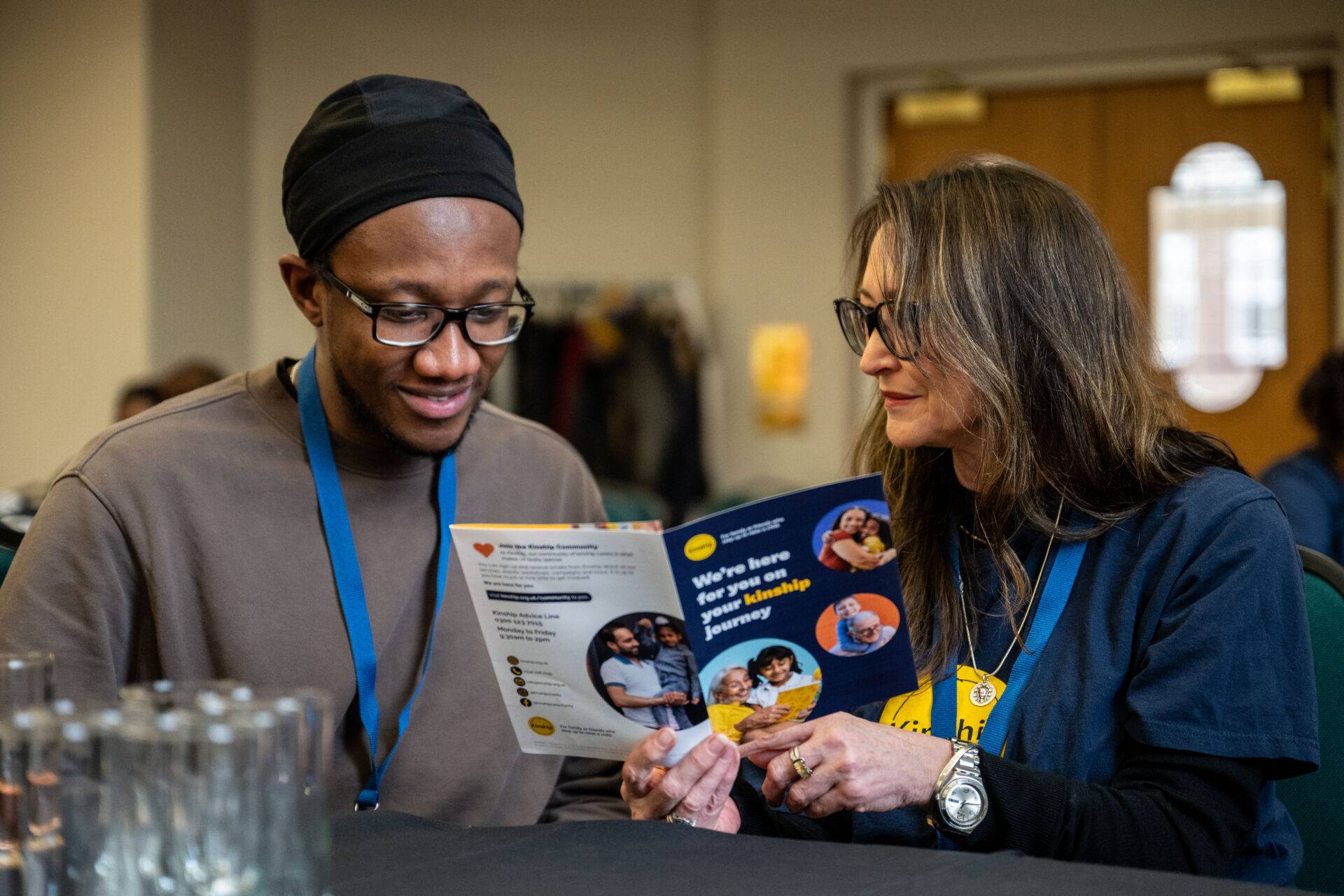
Information on the kinship local offer, why you must involve kinship carers in developing your offer, and how Kinship can help.

For family or friends who step up to raise a child.
27 March 2026
I was delighted have a conversation recently with Louise Spragg, Principal Social Worker, about the work Telford have been doing to produce their kinship local offer.
I’m a kinship carer and I’m also a trustee for Kinship, and I’ve been very pleased to be involved as a ‘critical friend’ with this work. It’s been a really wonderful experience. I can’t say how highly I regard the processes that they’ve been through to actually reach their offer.
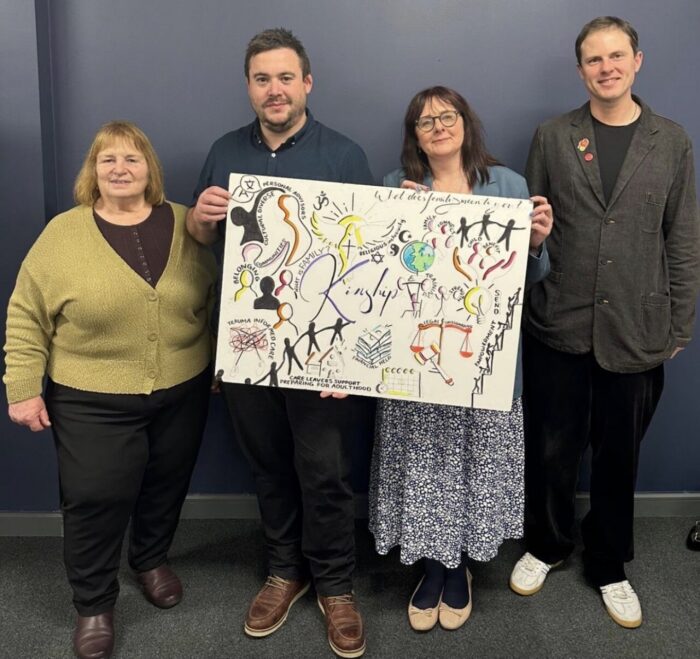
I first asked about what sort of thought processes and discussions went into deciding on the structure of the approach, because I was really impressed with how well this worked.
And what Louise said, in essence, was about principle and practice: her absolute belief in co-production, and then the logistics of how you actually bring people together effectively to make this real.
She said they already had a strong co-production element, but realised they hadn’t really extended that to carers, particularly kinship carers. She talked about holding a lens to the existing system and then asking whether that matched what carers think. And she described their genuine commitment to be collaborative and to not be tokenistic in terms of co-production.
"We didn’t really know how to engage carers."
Louise Spragg, Principal Social Worker
Because the truth is: I didn’t get a whiff of tokenism.
And my tokenism radar is very finely tuned. I felt Louise and the team were totally genuine in wanting to really know what carers needed and wanted- what was really important to them?
And it was not just about gathering views.
Bringing carers together and promoting belongingness was so significant, because isolation is like a disease among carers. It leaves people in places where they really struggle to cope at times. And actually, by bringing carers together, that created a really positive ongoing effect that’s going to take them forward really well.
So I felt that through this part of the process Louise and the team built a lot of relationships between professionals and carers, but also between professionals, and between carers.
And that in itself, because in the end all human activity works on relationships,was one of the most positive things they got.
What struck me initially was when Louise said that at first, “we didn’t really know how to engage carers.”
So they opened up an invitation to “come and talk to us” with no agenda.
And I love that idea: less agenda, more carers coming to you with what they want.
And they did the survey of what carers needed which was developed by carers—and this was a really good start, but they didn’t just do a survey and think job done.
They went on to do meetings with carers to discuss and ask what their priorities are.
That’s about being very thorough, and trying to get a wide range of carers involved, because we’re not all the same so a token few carers would not have given them the full picture.
And I think what Louise could feel was the commitment growing as carers and professionals increasingly engaged with the process. And one of the things I really liked was how that commitment was nurtured so it became a very positive process.
"I think it’s been vulnerable sometimes and for me, the best kind of leaders are vulnerable. They lead from the heart, and then it is genuine."
Louise Spragg, Principal Social Worker
I also think being willing to be open, even if it means uncomfortable moments, is really important.
Louise led really well on that, because it is hard sometimes when teams have to hear criticisms or hear that systems have failed kinship carers.
But systems have often failed kinship carers.
Louise put this beautifully, and I wouldn’t improve on it:
“I think it’s been vulnerable sometimes and for me, the best kind of leaders are vulnerable. They lead from the heart, and then it is genuine.”
And I think this work showed something really important: you have to be open and curious rather than defensive.
Involving carers like this is important in terms of developing autonomy, because kinship carers often feel powerless.
They feel they haven’t had power to make decisions, or decide how things are going to look.
Giving them that say really matters.
Involvement changes people. It empowers kinship carers to think beyond accepting that things aren’t great, or that support is just something they can’t get.
And I think it changes some of the professionals as well — seeing us in different ways, and seeing who kinship carers really are.
There were also concrete things in the offer that are, frankly, enviable.
I am pretty jealous about the inclusion of systemic therapy- Louise knows I’ve tried to kidnap her therapist several time!
To be able to access therapeutic support without having to go through endless hoops and waiting lists is a real positive for carers.
And it isn’t just the children.
Everybody in those families has suffered some sort of trauma.
The children are traumatised automatically by the loss of parental care and the events surrounding that. Kinship carers are traumatised by having their lives ripped out from underneath them and changed completely. So the recognition that we need help with that rather than just accepting that it’s something that happens to us is really significant.
The parent worker is absolutely crucial too.
For so many kinship carers, the issues around contact and relationships with birth parents are the hardest thing they experience.
And often they’re just left to get on with it.
It’s a minefield for kinship carers, and they don’t always feel confident making decisions, especially when they’ve got a court order and they’re dealing with anger, grief, and sometimes abuse.
Having somebody who can help birth parents to be in the best place with the family is absolutely crucial, because it’s a huge problem.
And then there’s Family Group Decision Making and circles of support.
That matters because it’s not just “a child protection thing” or “a going to court thing”. It’s about bringing family together well, repairing ruptures and involving other family members to support the carers.
That’s why the final meeting didn’t just feel like a celebration of something finished. When I thought about it afterwards, it felt like a consolidation of relationships, of trust, of thinking about and doing things differently, and then carrying that forward.
There’s another thing I want to mention: setting up the peer groups.
They are crucial in providing the community for carers to share and to support each other.
And they change people and give them power they didn’t know they had.
Mine all started when I rang Grandparents Plus because I was the loneliest kinship carer on the planet at the time. I literally didn’t know anybody who was also a kinship carer. So when you set up peer groups, it really does empower kinship carers, and it gives something that lasts.
And young people being involved matters too.
It was really great to meet the apprentices at the meetings, and to see that level of involvement.
Because if you’re serious about a local offer, you have to be serious about children and young people’s contributions too.
Their voices need to be heard to get this right.
In the end, for me, what made this stand out was simple: curiosity, openness, and a genuine commitment to be collaborative and not tokenistic and then the practical follow-through:
Louise and her team have created an approach to this offer which has empowered everyone involved, developed genuine co-production and set the tone for the future.
It’s a great offer and it been a fantastic experience to be involved with Louise and the team.
Nothing about kinship families should be designed without kinship families. We can help you bring carers and young people into the heart of your local offer. Get in touch to start that conversation with our Practice and Research team.
Information on the kinship local offer, why you must involve kinship carers in developing your offer, and how Kinship can help.

Find out what support kinship carers should generally expect from their local authority, and the legal duty they have to all children in your area.
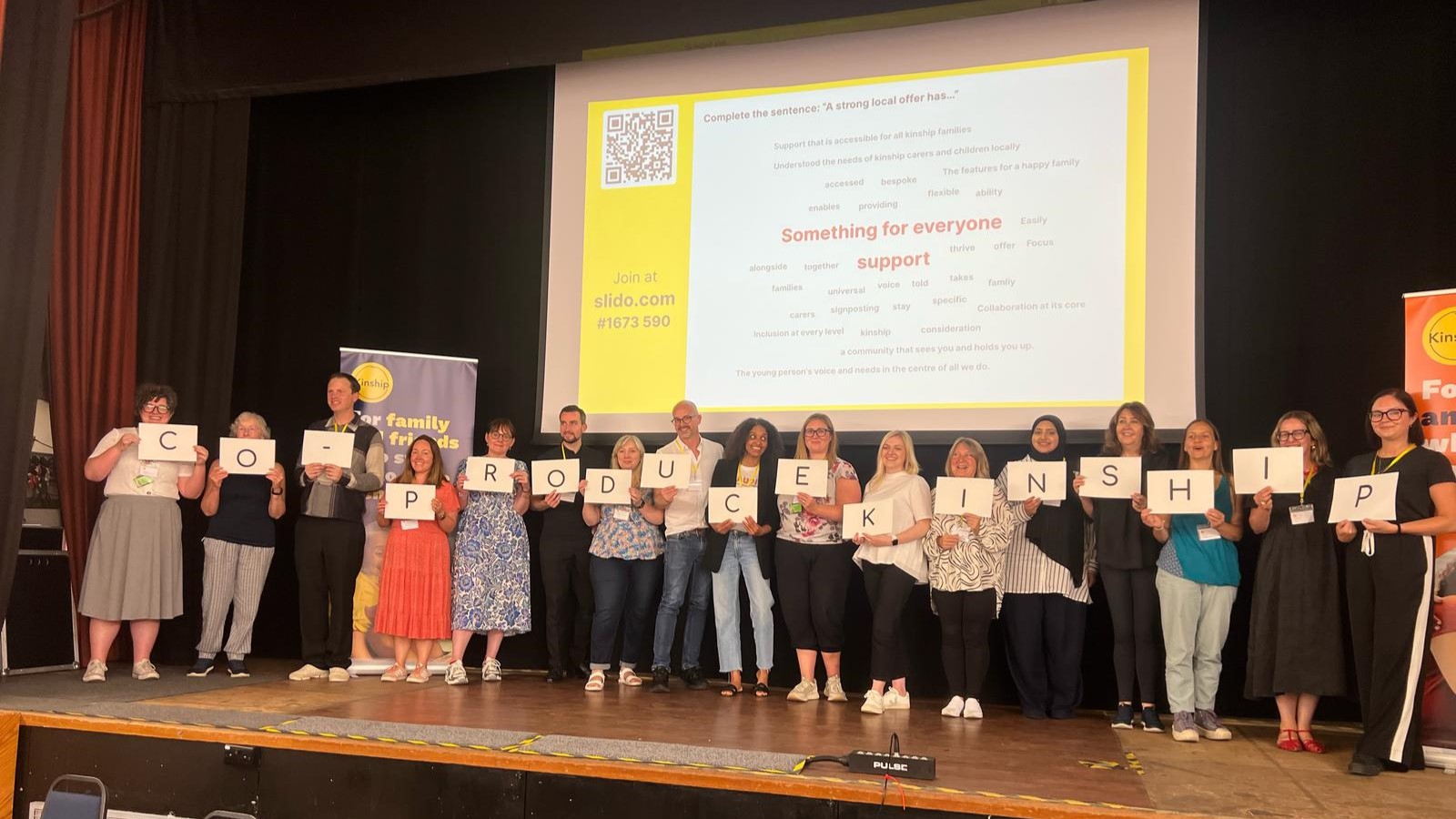
Kinship's Practice Lead, Tim Fisher, reflects on discussions from our Knowledge Exchange event about the kinship care local offer and the value of co-production in local authorities.
Sign up for emails to keep up to date with the information that’s important to you, from support and advice for kinship carers, to our latest news, events and campaigns.